Some Background: Social Circus

Circus itself has an incredibly long history,

possibly stretching back as far as prehistorical shamans performing wonders with objects and animals. More specific evidence however appears in the form of jugglers and contortionists on the walls of 4th century BCE Egyptian pyramids, and acrobats and jugglers painted or sculpted in Chinese art from the 10th century CE. The world ‘circus’ dates to the Roman era, where such entertainment took place in round or oval arenas. Modern circus is generally agreed to have begun with Philip Astley’s Equestrian Arena near Westminster, England in 1768. Social circus is significantly more recent, emerging sporadically around the world in the 1990’s and early 2000s. It was born from the contemporary circus movement that revitalized interest and love of circus arts, and of which Cirque du Soleil is perhaps the most renowned example.

Social circus,

also known as community circus, is increasingly being used to address various concerns of youth around the world. Much of the pioneering work has been assisted or led by Cirque du Monde. Begun in 1995, Cirque du Monde is a branch of the Canadian circus performance company, Cirque du Soleil, combined with the social services program Jeunesse du Monde. Cirque du Monde has been an influential proponent of social circus and social circus research, working with local partners to provide youth circus programs in more than 80 communities throughout the world.

The past decade has emphasized social circus research, and improved evaluation of effectiveness in particular, to rigorously demonstrate the effects that participants report experiencing and to increase funding opportunities. One of the landmark sources comes from Finland with the Social Circus Project (2009-2011) and the Effective Circus Project (2011-2014), which produced both research on social circus effectiveness and tools for circus organizations to demonstrate the wellbeing effects of their own activities. The push for more and better evaluations continues and efforts are multiplying monthly, as evidenced by the Evaluation Toolkit currently being assembled by the American Circus Educators (ACE), and the Cirque du Monde Box, both of which contain rich collections of research, teaching guides, and evaluation assistance, free for anyone.

According to the last recorded ‘census’ put together by Cirque du Monde, 502 social circus organizations and projects can be found in every corner of the world from Canada to Afghanistan, from New Zealand to Burkina Faso. The majority of programs are entirely devoted to social circus activities, however many other kinds of programs with a social circus component are present: recreational circus organizations, social organizations, professional circus troupes, or circus schools and educational institutions.

World of Social Circus Map as of October 2016

Why develop Evaluations for Social Circus?

Circus has always been on the fringes of society: a distant source of wonder, awe and unpredictability, possessing a sort of otherworldly and untouchable quality. The birth of community circuses though has shown that this assumption can be false. Community circuses function like any other youth organization in the neighborhood, just with more children (intentionally) flying through the air. Community circus was a step in the vibrant and dynamic circus history, moving farther from entertainment and closer to intentional social impact.

Evaluation is an important part of circus’s next step into social circus. With the new objectives of health and youth development, social circus needs tools to measure, improve, and display its worth to the scientific community.


References:

American Circus Educators (ACE). (2014). – Bolton, R. (2004). – Dip, S. M. 2003. Fournier, C., Drouin, M. A., Marcoux, J., Garel, P., Bochud, E., Theberge, J., . . . Fleet, R. (2014). – Cirque du Soleil. (no date). (2015). (2016). – Kinnunen, R., Lidman, J., Kakko, S., Kekäläinen, K. (2013a). – Kinnunen, R., Lidman, J., Kakko, S., Veikkolainen, A. (2013b).

Some Background: Youth Violence

In a world increasingly concerned about terrorist attacks, gun violence and abuse, there is a feeling of inevitability to violence. Violence seems too complex, too common to be successfully eliminated. Owing to that sensation of helplessness, it is rarely treated as an environmental contagion or a preventable behavior, and many of the innovative ways to prevent violence go unrecognized by the public health community. Potentially one of the most powerful of these overlooked ways is a holistic youth development technique called social circus. A relatively young field that, until recently, has been mostly isolated from scientific analysis, social circus has a unique appeal and utility for youth at risk for violent lifestyles.

Background: Youth Violence & Youth Violence Interventions

Violence is a major public health problem, disrupting the lives of youth throughout the world. “Violence” in this context is defined by a range of behaviors, ranging from bullying and physical fighting to sexual assault, physical assault and homicide. Homicide is the 4th leading cause of death of young people 10-29 years of age worldwide, and for every youth killed, many more sustain injuries and serious, lifelong consequences in psychological and social functioning. In the United States, violence is the third leading cause of death for young people aged 15 to 24 years, and each year, about $16 billion are lost in combined medical and work costs due to youth homicides and assault-related injuries. This violence becomes a vicious cycle, as many exposed youth will become violent themselves or display deviant behavior.

In this context, “at risk” is defined as youth who engage or are likely to engage in risky behaviors that are detrimental to their own development and to the well-being of their communities. The age group considered the most at risk for developing violent and criminal behavior is between 8 and 18 years old. Particularly at-risk are preteen males who are or who feel socially excluded; however youth of both sexes and of a range of ages can be violent or criminal actors.

Early intervention is of the upmost importance. Risky behavior tends to begin during this age of experimentation and will continue on into adulthood, so early intervention can reduce later hardships. Research has shown that young people who participate in one risky behavior are more likely to participate in many, so interventions should be aimed at multiple behaviors and factors. Individual risk factors of violent or criminal behavior consist of:

  • a history of violent victimization
  • attention deficits, hyperactivity, conduct disorders, or learning disorders
  • history of early aggressive behavior
  • involvement with drugs, alcohol, tobacco, or crime
  • low intelligence and educational achievement
  • poor behavior control
  • deficits in social cognitive or information-processing abilities
  • high emotional distress
  • antisocial beliefs and attitudes
  • exposure to conflict and violence in family
  • unemployment
  • and associating with delinquent peers and/or gang membership

Individual behavior and risk factors are crucial, but a youth’s environment is also fundamental in the likelihood of later problems. One’s family environment and parental involvement has been shown to be particularly influential. Family risk factors include authoritarian childrearing attitudes, extreme or inconsistent disciplinarian practices, low parental involvement, low emotional attachment between parents and children, low parental involvement in children’s activities, poor family functioning, and poor monitoring and supervision of children. A community with diminished economic activities or high concentrations of poor residents, that is socially disorganized and displays low levels of participation in youth lives also contributes to the risk that a young person will exhibit violent behaviors.

Social exclusion is considered an important contributing risk factor as well, as it has been posited that social inclusion, not nonviolence, is actually the opposite of violence. The Effective Circus Project in Finland specifically cited social exclusion as contributing to violent behavior, substance abuse and crime. The state of being “social excluded” is defined as young people, between the ages of 15 and 29, who are not employed or in school and who lack post-secondary education. It is closely associated to psychological problems, and the problems tend to accumulate, as the lack of social networks and education increase social exclusion and economic vulnerability. Youth of all ages are vulnerable to the effects of social exclusion, as all are active social agents capable of changing society.

Overall, this extensive array of risk factors and risky circumstances requires successful interventions to address multiple levels of society and multiple factors in individuals. Conveniently, this kind of approach is well reflected in social circus.


 References:

 Centers for Disease Control and Prevention (CDC). (2010). – Centers for Disease Control and Prevention (CDC). (2012). –  Jain, S., & Cohen, A. K. (2013). – Kinnunen, R., Lidman, J., Kakko, S., Kekäläinen, K. (2013a). – McCauley, J. (2011). – Minayo, M. C. D. S., & Souza, E. R. D. (1999). – Shuster, S. (2007). -World Health Organization (WHO). (2015, October).

Circus Resilience Theory Basics

How does Social Circus prevent Youth Violence?

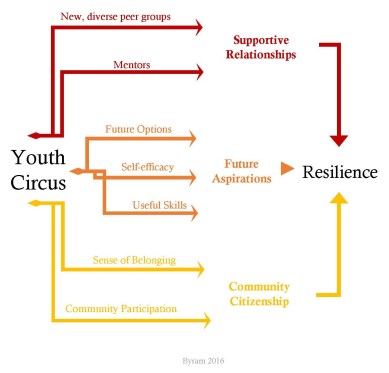
Inherent in its daily activities, social circus is an incredible tool to promote youth resilience and prevent youth from engaging in lifestyles characterized by violent behaviors. More than just “keeping kids off the streets”, this play-to-purpose transformative process works similarly to a Positive Youth Development approach and can be described by three pathways: future aspirations, supportive relationships, and community citizenship.

logic-model-pretty-cropped

  • Supportive relationships is about having role models in addition to building safe and encouraging peer networks. These relationships are a source of emotional and instrumental support for youth in their daily struggles, and can provide the necessary guidance to secure employment or apply to university.
  • Future aspirations includes a youth’s optimism about the future, expected educational achievement or careers, and the ability to set and reach useful goals. Due to difficult environments, many at-risk youth have low expectations for their futures; through incremental skill progressions, youth build self-efficacy and confidence to transcend their status quo.
  • Focusing on an individual’s unique contributions to the success of a team, the community citizenship pathway develops a youth’s sense of responsibility. The youth’s voice is heard and respected, empowering them to give back to their community and create their own social change.

For participating youth, the three pathways develop simultaneously and are strongly interdependent. This interdependency has consequences for successful evaluation, as the methods employed will overlap and interpretation of results will consist of fluid impressions, rather than discrete categories. Social circus additionally exhibits a dose-response relationship, increasing resilience benefits with increasing amounts of circus learning time.


Update: This article was featured on Clowns Without Borders USA blog!